


The Atomic Theatre (1985)
Ron Giii
Ron Giii & Mimmo Paladino
January 6 - January 28, 2006


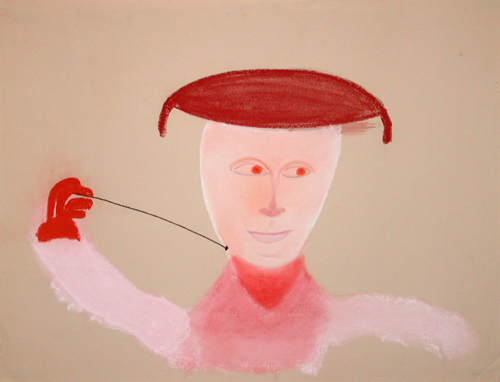
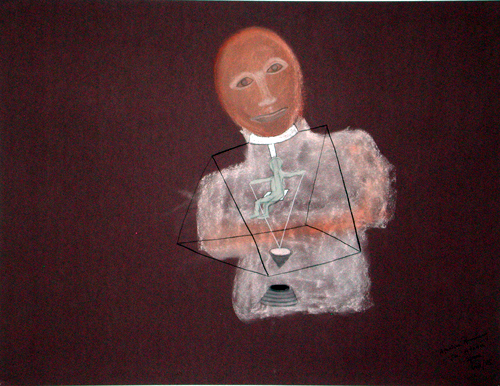
Paul Petro Contemporary Art is pleased to present a two-person exhibition, The Atomic Theatre, featuring oil pastels from 1984 (and an oil pastel from 1986) by Toronto-based artist Ron Giii and a suite of etchings from 1982 (and an oil pastel from 1986) by Mimmo Paladino.
Accompanying this exhibition is a re-printed text by Ron Giii first published to accompany his exhibition The Atomic Theatre and The Dictator's Opera at the 49th Parallel, New York, in 1986. This is one of the most significant texts on drawing by an artist that we have encountered.
Ron Gillespie was born in 1934 at New Westminster, BC. His earliest training in art took place in 1962-64 at H.S.C. Prince of Wales College, Nairobi, East Africa. He graduated from the Ontario College of Art in 1975 and established a signifant performance art practice during the 1970's. By the early 1980s he had moved into drawing while retaining a strongly performative element in the compositions. Philosophy, geometry and the anti- modern figure prominently in the work with influences including Artaud, Darwin, Hegel and Spinoza.
His drawing has continued to this day, marked by an exhibition history that includes shows at the 49th Parallel, NY, Cold City Gallery, Toronto, the Evelyn Aimis Gallery, Toronto and many group exhibitions including Heavy Mental, curated by Philip Monk at The Power Plant, Toronto. His work is in the permanent collections of the Art Gallery of Ontario and the National Gallery of Canada amongst many others. This is Ron's fifth exhibition with Paul Petro Contemporary Art.
Mimmo Paladino was born in 1948 at Paduli, Italy. He attended the Liceo Artistico di Benevento from 1964 to 1968. In the early 1970s he concentrated on drawing, developing much of the imagery that later appeared in his paintings. He had his first solo exhibitions in 1976 at the galleries D'Arte Duemila, Bologna, and Nuovi Strumenti, Brescia. He moved to Milan in 1977, and during the late 1970s he produced mostly monochrome paintings in blue, red or yellow, often incorporating found objects. In 1980 he was associated by the critic Achille Bonito Oliva with the 'Transavanguardia' painters Sandro Chia, Francesco Clemente, Enzo Cucchi and Nicola De Maria and his work was shown at Sperone Westwater in New York. He rapidly developed an allegorical figurative style, drawing on imagery from Christianity and Classical mythology, while also being influenced by ancient Egyptian, tribal and modern art. He created enigmatic archaic figures exemplifying his preoccupation with the themes of death and sacrifice. Paladino's technical versatility also extended to various forms of printmaking (from 1980), including etching, linocut and aquatint.
--
On the occasion of The Atomic Theatre, a two-person exhibition featuring pastels from 1984 by Ron Giii and etchings from 1982 by Mimmo Paladino
I remember when Richard Rhodes organized an exhibition of Ron Giii's works on paper in 1987 at the Cold City Gallery in Toronto. He had seen "The Atomic Theatre" and "The Dictator's Opera" in New York at the 49th Parallel in a show organized by France Morin in 1986. Some of these works had been shown the year before at Postmasters, also in New York. Following the Cold City show I acquired "Mathematicus" from "The Dictator's Opera" (included in the current show) at their annual Christmas group exhibition. It was my first acquisition that resulted from a purchase rather than a trade or a gift and brought the stake in my personal art collecting to a new level.
At the same time I was working in Yorkville as director of the Evelyn Aimis Gallery. Mimmo Paladino was on the roster of international artists showing at the time. Works by Francesco Clemente, Enzo Cucchi and Sandro Chia also passed through the gallery and a keen familiarity with their material properties, in addition to an understanding of their connections with Achille Bonito Oliva's "Transavantgardia" (1980), ensued. It had been three or four years since "The European Iceberg" group exhibition had been mounted at the Art Gallery of Ontario. This show included many Italian and German artists, Paladino being among them.
I searched out Ron and his work in the following year, 1988. He had just completed a body of work that he called "The Gas Works" and invited me over to meet him and have a look. Back from New York, he was house-sitting a friend's townhome nearby Adelaide St West and Strachan. He unrolled the works and they emitted an acrid plume of I-don't-know-what that caused my eyes to tear. The works were made up of a combination of materials including varsol, shoe polish, molasses and oil. They were 43 x 29 inch vertical works with a single floating head in the upper middle section of the paper on an amorphous cloud-like ground. He had saturated the paper with vegetable oil before the application and dispersion of the other media. They were portraits of the artist's friend after forty shock therapy treatents. I selected a few of the works for a group exhibition I was organizing and calling "Body Is A Loaded Word".
Over the next few years I would show four additional bodies of work, including a full presentation of "The Gas Works", "The Bourgeois Opera", " The Anti-Conscious" and "The Geometry Shop". I became Leo Castelli to his Uncle Ron (or Johnny Pizza, as the case may be) and our conversations were unlike any other. The war in the Gulf Islands happened some months after the making of "The Gas Works" and became a post-script to the Persian titles he had given the works. I discovered a level of prescience to so much of his work and this idea became manifest in the words he associated with them, in many cases written down on the work itself. Ron's performance work in the 1970's, during and following his schooling at the Ontario College of Art (1972-75) set the stage for his drawing. Ron talks about the "transparent laws of geometry" which inform the compositions his figures inhabit. This architecture finds its roots in the spontaneous activity of theatre, in the false prosceniums which frame the figures in his current work, and in the sets his figures inhabit in "The Atomic Theatre". Ron offers the following equation, " geometry and theatre equals time and chemical space".
An interest in developmental biology further informs the work - DNA theories and genetic evolution. Ron says that "at a cellular level there are molecules which behave in a very specific way, and this behavior became better understood when gene theory reached a certain level. And with AIDS it became politicized." He refers to the lone figure in his work and the predicament of the outsider, who "has no way of speaking out in his or her language without causing problems with the State", at which point he mentions China, Iran, Syria, Lebanon and totalitarian fundamentalism. He states that in 1984 "we were looking at the antics, the shape of terrorism" and he mentions the group exhibition at Postmasters in 1985 where "The Atomic Theatre" works were first shown. He also mentions the return to fascism and the rise of Reagan. Born in 1944 in Westminster, BC, Ron received his earliest schooling in art in Nairobi (1960-62) where his father, a member of the diplomatic core, was then stationed. The influence of African tribal art is a good starting point when exploring the connections between Ron Giii and Mimmo Paladino's work and is apparent in the faces that proliferate in their respective works. In the case of each of these artists the faces are mask-like and the impulse is to find out what is behind these formal surfaces.
With Paladino we encounter imagery steeped in Christianity and Classical mythology, figurative and allegorical, with dominant themes of death and sacrifice. Rather than articulating a theological, mystical or spiritual position Ron's works are deeply philosophical and humanistic. Ron cites influences which include Artaud, Darwin, Hegel, Schwarzkogler, Spinoza and the Frankfurt School, in particular Walter Benjamin. Ron reads the London Economist and the New York Times. The work is non-gendered, existing outside of meaning and representation. Ron says that "getting involved with meaning" is trouble. The simplicity in his work portrays the artist as looking to simplify himself.
The formal attributes that Ron Giii and Mimmo Paladino share in their work ultimately reveal the vast extent to which they differ. The differences become amplified upon extended viewing. The three years between Ron's performance work and the arrival at "The Atomic Theatre" was a period of experimental drawing that landed him in a "journey through space and time with no beginning and no end." His reading of Nietzsche's "Twilight of the Idols" at this time led Ron to "(feel) for the first time that notion of the 'eternal recurrence' which had evaded my art thus far. The faces in 'The Atomic Theatre' smiled like human beings yet they would disappear just when I was on the verge of understanding their emotions. I realized that my drawings were laughing and hiding from me as if they had their own reality. This discovery became the central focus of the work; as each drawing possessed another layer which extended beyond my normal perception of reality. This key moment;, when a sign becomes both real and unreal in the same split second; ws my introduction to the world of the 'eternal recurrence'."
These words, originally published to accompany the exhibition of "The Atomic Theatre" in 1986 at the 49th Parallel in New York, have carried forward with each consecutive body of drawing that Ron has produced over the last twenty-two years. They stand as some of the most significant words on drawing by an artist. In a separate room to the current exhibition twelve new works have been installed. Following the Evelyn Aimis years and a group exhibition called "Heavy Mental", curated by Philip Monk in 1993 at the Power Plant, Toronto, Ron's work has appeared in many group shows and has shown four times at Paul Petro Contemporary Art.
In 2003 Ron produced and exhibited a body of new work he called "The Dreamer". When asked why he chose that title he said, simply, that " dreamers never give up". He telephoned the other day and said, with excitement, that he had "finished another one", at which point he hopped on a bus, the years fell away, labour was rewarded and, well, the feeling was atomic.
- Paul Petro, January 10, 2006
--
The Atomic Theatre and The Dictator's Opera (1984-86) - 49th Parallel, NYC, 1986
by Ron Giii
To open the doors of the Atomic Theatre your eyes have to open up like a vast reservoir of water falling from another planet. Once the mind has turned inside out, the springs of time will emerge as the centre of your cognition. The Atomic Theatre takes its pulse from the anti-matter of materials that exist in an unknown dimension called invisibility. The material is chalk and pencil with the intangible edge of feeling as the centerpiece upon which the drawings live side by side. Each drawing stays in its own time power as if seduced by the creative force of humanity. Each instance of conception is a view of a theatre that has no words nor semblance of a rational world with all its contradictions and confusion. Indeed, the Atomic Theatre is that world where the formless components of atoms are released like charges of energy that evaporate into the sun and its radiation.
The translucent world of the Atomic Theatre was first conceived in the body art silence of desire and sexuality that was the main focus of my work during the 1970's. Desecrating space and the eruptions of tiny time capsules were central to the early work- each movement on stage became an opening to another world where the laws of action were undiscovered and liberation of the spirit was always close at hand. Making the quantam leap into drawing was as natural as opening and closing a door. However, the magnitude of time and space was altogether a new experience in which the exhilaration was of a different nature- like a new wine, sharp to the taste.
To relate the drawings to performance art, I decided to construct an entire theatre. Each small drawing would behave as an actor endowed with the right amount of electrical balance necessary to maintain the overall production. The art of balance- its timing and placement- preoccupied me for three years. Finally, in 1983 I knew that the Atomic Theatre was transferring all its power into one final stage in which all the faces had a special space in and amongst all the other drawings. Without any pre-knowledge on my part, this formless world pulled me into its own colours and space. The entire work became a journey through space and time with no beginning and no end.
The Atomic Theatre passed into this timeless world where the spirit and the magic of drawing deepened in my mind like a star that had no connection to reality. Reading Nietzsche's Twilight of the Idols, I felt for the first time that notion of the "eternal recurrence" which had evaded my art thus far. The faces in the Atomic Theatre smiled like human beings yet they would disappear just when I was on the verge of understanding their emotions. I realized that my drawings were laughing and hiding from me as if they had their own reality. This discovery became the central focus of the work, as each drawing possessed another layer which extended beyond my normal perceptions of reality. This key moment, when a sign becomes both real and unreal in the same split second, was my introduction to the world of the "eternal recurrence". A symbol at one level became different at another level. A piece of string or a cup of water in the foreground of the picture was quite capable of many tiny explosions. The more I saw, the less I actually knew. Finally, I realized that the drawings breathed more life into my spirit when I simply gazed at them, my eyes totally open and aware of the boundaries and distances in the works. The key to the drawings lay in the use of chalk and pencil which created a softer atmosphere and a greater sense of transparency. Space could shape itself naturally, its timing all its own. the sense of timing was so different from what I had experienced in performance work, that it was like entering a new dimension where a field of golden eyes could become a vapour or a gas with no earthly connection. Convinced of the magic qualities of the chalk and pencil, I decided to draw the larger full figure with as much vitality as possible.
As the full figure emerged and I began to play with movement and balance, I began to view these figure as characters having their own distinct qualities of light and absorption. I had the feeling that I was merely directing a cast of characters who already knew they were on stage. Some figures became slightly evil while others grinned or smiled at me as if their expressions were painted on like a mask with many layers.
As my knowledge of opera comes from the European stage, I viewed the figures as a group of characters from the music of Mozart. I saw my opera as embracing the whole gambit of human folly in one large production rather than concentrating on just a few aspects of the human condition. The more I observed the new work, the more I became convinced that this was an opera about power and about rulers who had their own control over history despite the forces of nature. Each drawing became an entity unto itself. I also saw the theatre of time as the grand ruler of each piece and the entrances and exists from the black paper became more and more central to the overall stage.
By this time I knew I had to arrange the work in some sort of order that would build up the sense of mystery and magic. This became another preoccupation; some figures assumed a medieval character while others became more primitive. I soon realized that I would have to assume the role of conductor, composing an arrangement that would have all the tensions and contradictions of nineteenth centruy opera. I began placing the figures next to each other as if they were preparing to say something grand or provocative, until I realized that a conductor, in the true sense, is a Dictator who stands alone, isolated from the human condition. Acting on the feeling that not all rulers are equal, I began to see some of my figures as jesters or magicians. Others became clowns or buffoons who saw the world as a very wicked place. The whole production came to portray both good and evil as well as pleasure and fear.
Returning to the "eternal recurrence" and its theme of evil and love dancing in the same house of cards, I knew that the key to timing in the art of drawing was its capacity to allow entry into its world at many different levels or shades of mystery. This chemical feeling in drawing or metaphysical space involves a lifetime of exploration into its complexities. There are very few rewards other than the feeling that you must go on with a sense of risk, as each drawing takes you further along the eternal river of no return. To dance in drawing is full of twists and turns yet its intoxicating nature will continue on as its power is one of the most seductive acts of love you can master.
Finally, chalk reveals a type of space where a high transference value allows major and minor forces to work in the same picture. After looking deeper and longer into the texture and matter of the drawing, lines begin to appear and reappear. This type of residue opens up the formless transmission into an empty world and dissolves the hard edges into shades and degrees of timing which are central to the work.
To hesitate during the moment of conception is like losing your breath- the chalk dares you to go over the edge and lose the chance to find the perfect moment when all the forces are at the height of their value and power. The power in drawing is like a magnetic cloud that floats just above your head as you search for that magical smile or attractive colour that meets the needs of the picture. Each close shave with disaster is like walking a tightrope: the end is in sight yet you are walking in the dark and you cannot see where you have come from. It is this sense of timing that the Atomic Theatre and the Dictator's Opera continually play with and it is in this timing that the musical and phosphorescent display keep the conditions of the work always on the edge. The final work has evolved after many false attempts and missed opportunities at finding the right moment for all the components to mix in atomic harmony. In this respect, the political or social fabric is always on the threshold of exploding, blowing up the order of arrangement of reality. Thus, in many ways the drawings reach the edge of time before a disaster occurs and in this narrow precipice lies human courage and subtlety. While the Dictator often goes over the edge in excessive abuse, it is a fact of the human condition that others will follow. Many will never return from that space.
The art of knowing when a picture is at its highest moment or deepest space is the result of a long and often tedious labour of love. Yet, the rewards of finding this timing in art are so rich and varied that one can never really grasp the perfect moment- the instant you recognize it, it is gone like a vapour.
- Ron Giii, 1986